Skip to content

Fibre-optic border protection system

Border protection

Reach from one point
Sections on one link
Powered devices in the strip
Monitoring and reporting

A border that reports itself

Continuous linear monitoring of a border strip along a fibre-optic cable: one already in the ground, or one laid together with the barrier. The cable works as a sensor along its whole length, detects zone breaches, vibration, footsteps and other acoustic and seismic signatures, locates the event and passes it to the command centre. Cover is round the clock and reaches sections no patrol can hold.

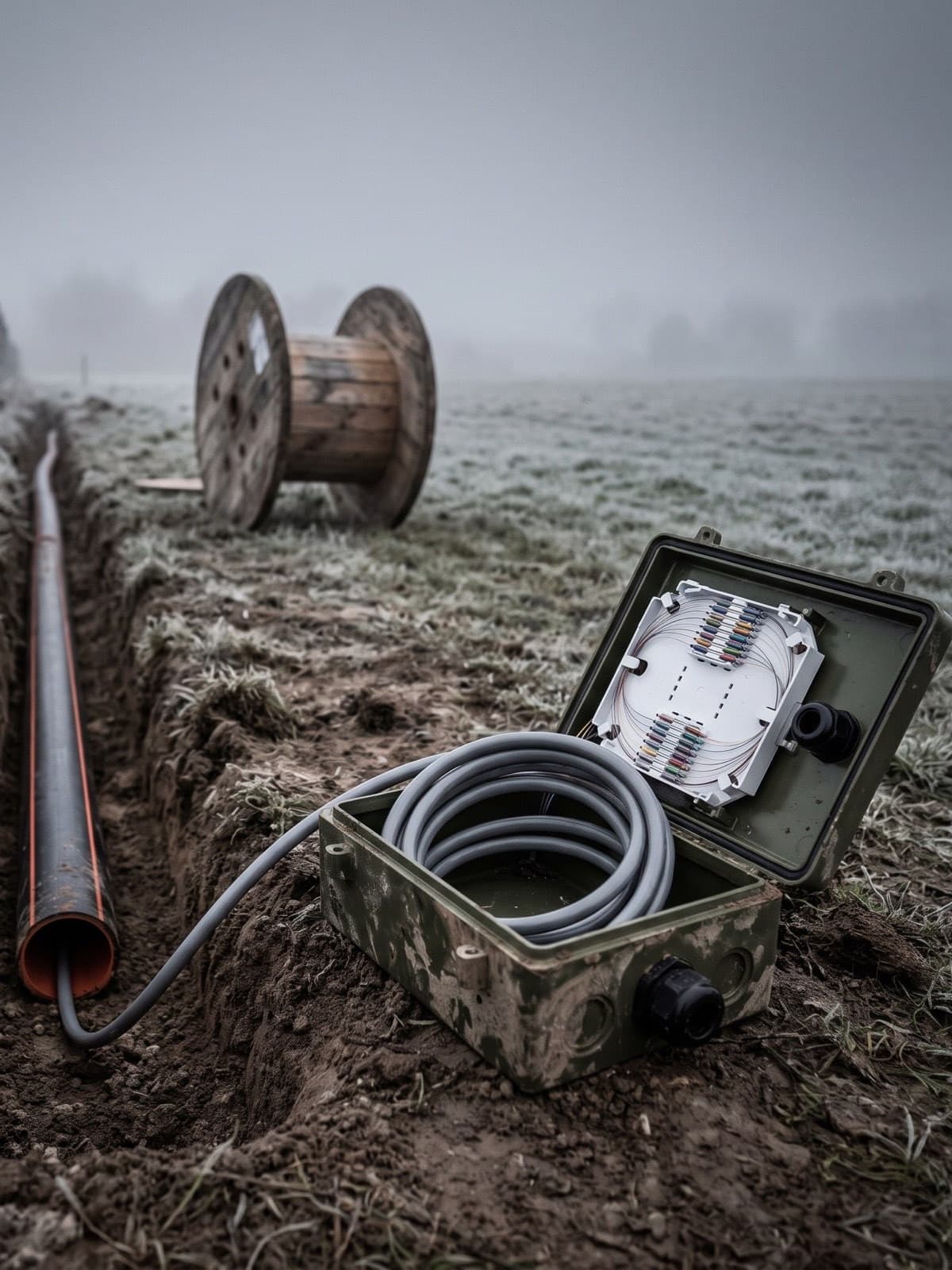
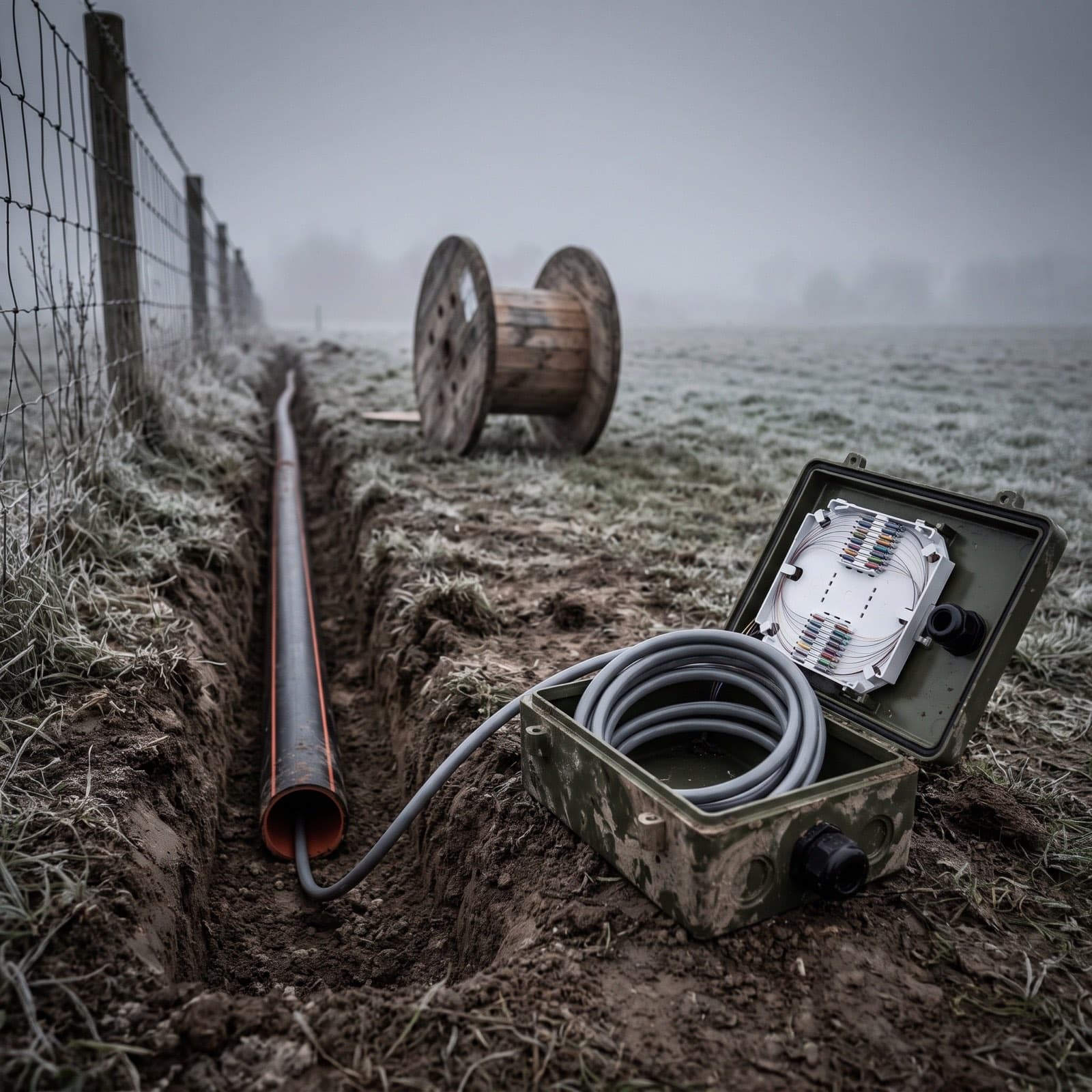
Fibre-optic cable leaving a protective duct into an open splice closure in a trench beside a fence

Fibre as the sensor

Distributed acoustic sensing

A laser sends pulses into the cable, the light backscatters off the fibre's natural imperfections, and the interrogator reads that return thousands of times a second. The cable stops being a link and becomes a linear geophone: every stretch of the route is its own measuring point, listening to the ground above it. The line is passive - not one powered device stands in the strip to be located, jammed or stolen - and it works on cable already laid or laid with the barrier.

Principle
Distributed acoustic sensing (DAS)
Sampling
Thousands of readings per second
Reach
Up to 80 km from a point, in two 40 km sections
Power in the strip
None, the line is passive
Cable
Existing or newly laid, in the ground
Self-protection
Tampering with the cable is itself an event
Location resolution
not published

What the line hears

  • Groups on foot

    A group entering the border strip and the buffer zone sounds different from an animal or from wind. The report carries a position on the route before the group reaches the barrier.

    Signature
    footsteps, group movement
    Report
    with a location on the section
  • Tunnels and digging

    Digging travels through soil, not air, so a camera will not see it. Tools working below the surface leave vibration in the ground and the line reads it from the same cable.

    Phenomenon
    concealed earthworks
    Layer
    below ground level
  • Attack on the barrier

    Cutting a span, drilling, sawing and dismantling structural elements, mechanical impact, ramming, explosion. Each of these events has an acoustic picture of its own.

    Classes
    cutting, drilling, ramming
    Response
    alarm at the moment of the event
  • Vehicle movement

    A vehicle approaching the strip and unauthorised movement on service roads are heard in advance, including at night and in fog, when the optical channel is not working.

    Object
    wheeled vehicle
    Conditions
    night, fog, precipitation

What happens after the event

  • Sensor fusion

    The fibre line, thermal cameras, radars and sensors on the barrier itself also work separately, but only together do they close the gaps. What one sensor does not hear, another sees.

    Layers
    ground, barrier, air
    Operation
    independent or combined
  • Airborne reconnaissance

    An event on a section produces coordinates, so the aircraft flies to a point rather than in a direction. Radar adds the air layer to the same picture.

    Input
    coordinates from the line
    Output
    imagery from the scene
  • Forces on the ground

    The response team drives to a point from the line rather than to the description in a call. Positions of one's own patrols, on foot and mounted, can be carried in the same picture.

    Response
    from the event, not from a call
    Patrols
    positions in one picture
  • Console and sections

    Operation runs from a single console or split into sections assigned to individual posts. Planned work - barrier maintenance, road repair, tree clearance - suppresses alerts on its own section, so there are fewer false alarms. Events can be passed upward to higher-level systems.

    Operation
    central or by section
    Planned work
    alert suppression on a section